
After flying in and out of Bologna airport multiple times for road trips around the Emilia-Romagna region, I was finally excited to properly visit the city itself. And honestly, the thing that had me most hyped wasn’t the architecture or history; it was the food.
Bologna is famously known as “la grassa” (the fat one), and I was more than ready to eat my way through it.
With just 48 hours, I wanted to fit in as much as possible, so I planned ahead, booked a few restaurants, and built a list of dishes I absolutely had to try.
The Best Way to Start: A Food-Focused Walking Tour
One of the best decisions I made was joining a free walking tour, called Sights, Stories and Taste of Bologna.
What I loved most:
- It covers many key spots in the city centre
- But more importantly—it dives deep into Bologna’s food culture
There’s nothing I enjoy more when travelling than understanding what I’m eating, and why. And in Italy, that matters even more because every region has its own identity through food.
Just like in Rome you eat carbonara, amatriciana, cacio e pepe, and gricia…
In Bologna, it’s all about:
- Tagliatelle al ragù
- Lasagne alla bolognese
- Tortellini in brodo
The Food You MUST Try in Bologna
Here’s exactly what I had on my list and what you should look out for too:
Tigelle
Small round breads filled with cured meats, cheese, or spreads.
You’ll find them all over the centre, especially along Via Indipendenza and near Piazza Maggiore.
A great spot: Tigelleria Tigellino
Mortadella
You’ll see it everywhere—every salumeria, every platter.
I’ll be honest… it wasn’t my personal favourite.
But it’s a local staple, and worth trying at least once.


Pictured above: Simoni and Tamburini — two of Bologna’s most popular historic salumerias, loved for their high-quality cured meats, cheeses, and authentic local food products.
The Holy Trinity: Pasta Dishes
I tried all three, and honestly, you can’t go wrong anywhere in Bologna but one stood out for me:
Tortellini in Brodo (my favourite)
Small, delicate pasta parcels served in a clear broth.
What’s inside?
Traditionally:
- Pork loin
- Prosciutto
- Mortadella
- Parmigiano Reggiano
They’re handmade and incredibly rich despite their small size.
You can also buy fresh tortellini to take home from pasta shops around the city.

Tagliatelle al Ragù
Flat egg pasta with a slow-cooked meat sauce.
Important: this is the real “bolognese” not spaghetti.
Lasagne alla Bolognese
Layers of:
- Green spinach pasta sheets
- Beef ragù
- Béchamel sauce
Rich, and comforting.
Where I Ate It All
One place I highly recommend: Al Sangiovese
- About 15 minutes from Piazza Maggiore
- Full of locals
- Serves all three classic dishes
We also had beef with balsamic vinegar sauce, which was incredible. Look out for it.

What to Drink
- Lambrusco – a lightly sparkling red wine
- Pignoletto – a fresh local white
Gelato Stops
We really wanted to try Cremeria Cavour, but the queue was insane every time we passed.
Tip:
The only time it was quieter was around 8pm, when most people are at dinner.
Instead, we tried Venchi; great gelato, and no queues.
A Very Local Experience: Osteria del Sole
One of the most unique spots in Bologna: Osteria del Sole
- No food served
- You bring your own from nearby salumerias like:
- Simoni
- Tamburini
And enjoy it with wine inside.
It’s a true local institution and one of the coolest experiences in the city.

Best Area for Food: Quadrilatero
The best place to sample everything, especially during aperitivo is in the Quadrilatero district. Via Drapperie and Via deele Pescherie Vecchie.
This area is packed with:
- delis
- wine bars
- street food
Do not miss it!
We tried 051 for aperitivo while in Bologna, and it didn’t disappoint. We ordered a tagliere (a platter) and it came with different kinds of meats and cheese, alongside a bread basket including piadina from the region as well as tigelle. Paired with a glass of wine and good company, it’s honestly one of the best ways to spend an afternoon in Bologna.
Beyond the Food: What I Loved in Bologna
Even though I came for the food, the city itself genuinely surprised me. It’s easily up there with my favourite cities; less chaotic than big cities (like Rome, Venice, or Milan), which made it feel even more charming and enjoyable to explore.
Piazza vibes
The walk from Via dell’Indipendenza to Piazza Maggiore is beautiful, especially on a sunny day with live music in the square.
The university & porticoes
The courtyard of the Archiginnasio is stunning, but what makes it even more special is the history behind it. Bologna is home to the oldest university in the Western world, founded in 1088!
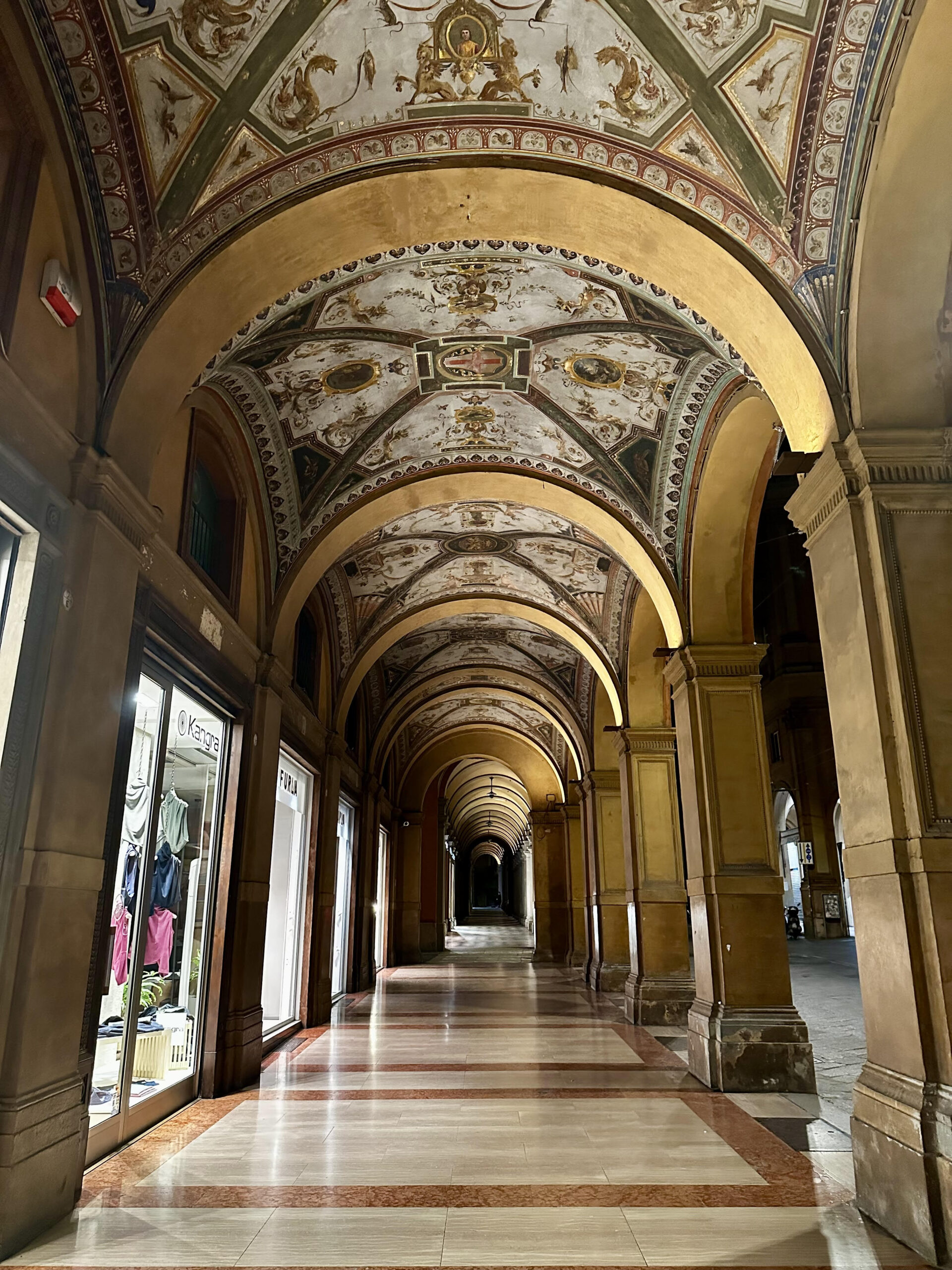
Then there are the porticoes; one of the most distinctive features of the city. Stretching for over 60 km, these covered walkways line the streets of Bologna and are even UNESCO-listed. They were originally built to expand living space while protecting pedestrians from the elements, but today they give the city its unique character.
Walking under them is an experience in itself, whether it’s for shade from the sun, or shelter from the rain. The porticoes around the centre, especially near Cremeria Cavour, are some of the most beautiful, and they make wandering through Bologna feel effortless and atmospheric.


Complesso di Santo Stefano
The square around Santo Stefano was one of my favourite spots and easily one of the most atmospheric corners of Bologna.
Often referred to as the “Seven Churches” (even though not all seven remain), this complex is made up of a group of interconnected religious buildings dating back to different periods. As you wander through, you move between small courtyards, cloisters, and ancient chapels, each with its own character.
It’s a peaceful contrast to the busier parts of the city, and one of those places where you can slow down and really take in the history. The square outside is just as beautiful; perfect for sitting down for a moment and soaking up the atmosphere.


The Two Towers
Of course, the iconic Two Towers; a must-see and the symbol of Bologna.
These medieval towers, Torre degli Asinelli and Torre Garisenda, date back to the 12th century and once formed part of a skyline filled with hundreds of similar structures, built by wealthy families as a sign of status.
Today, only a few remain, and these two are the most famous, especially for their noticeable lean. While visitors are no longer allowed to climb Torre degli Asinelli, which once offered panoramic views over the city, seeing them from the streets below is still incredibly impressive.

Portico di San Luca
We didn’t end up doing the Portico di San Luca walk ourselves, but our guide mentioned that if time permits, it’s one of the most beautiful experiences in Bologna.
This is the longest portico in the world, stretching nearly 4 km and made up of 666 arches, leading from the city all the way up to the Sanctuary of the Madonna di San Luca, a hilltop church overlooking Bologna with incredible views over the surrounding countryside.
Since it’s a fairly long and slightly uphill walk, a great option is to take the little red train from Piazza Maggiore up to the sanctuary, and then walk back down under the porticoes. It sounded like the perfect balance; still getting the full experience without the effort of the climb.
Even if you don’t do it, just knowing it’s there really highlights how unique and special Bologna’s porticoes are.
My Take on Bologna
Bologna completely lived up to the hype.
For me it was all about:
- eating incredible food
- drinking local wine
- and just soaking in the atmosphere
And for a first visit, even with just 48 hours, it delivered more than I expected.
If you’re a food lover, this city is an absolute must.
And if you’re anything like me; you’ll leave already planning your next trip back!
Happy Travels! x
Travel is better when shared. Come be part of my journey on social media, where I swap stories, tips, and travel inspiration with fellow explorers.
Disclaimer: All content and photos in this blog post are my own unless otherwise stated. Please do not copy, reproduce, or use any images or text without written permission.