
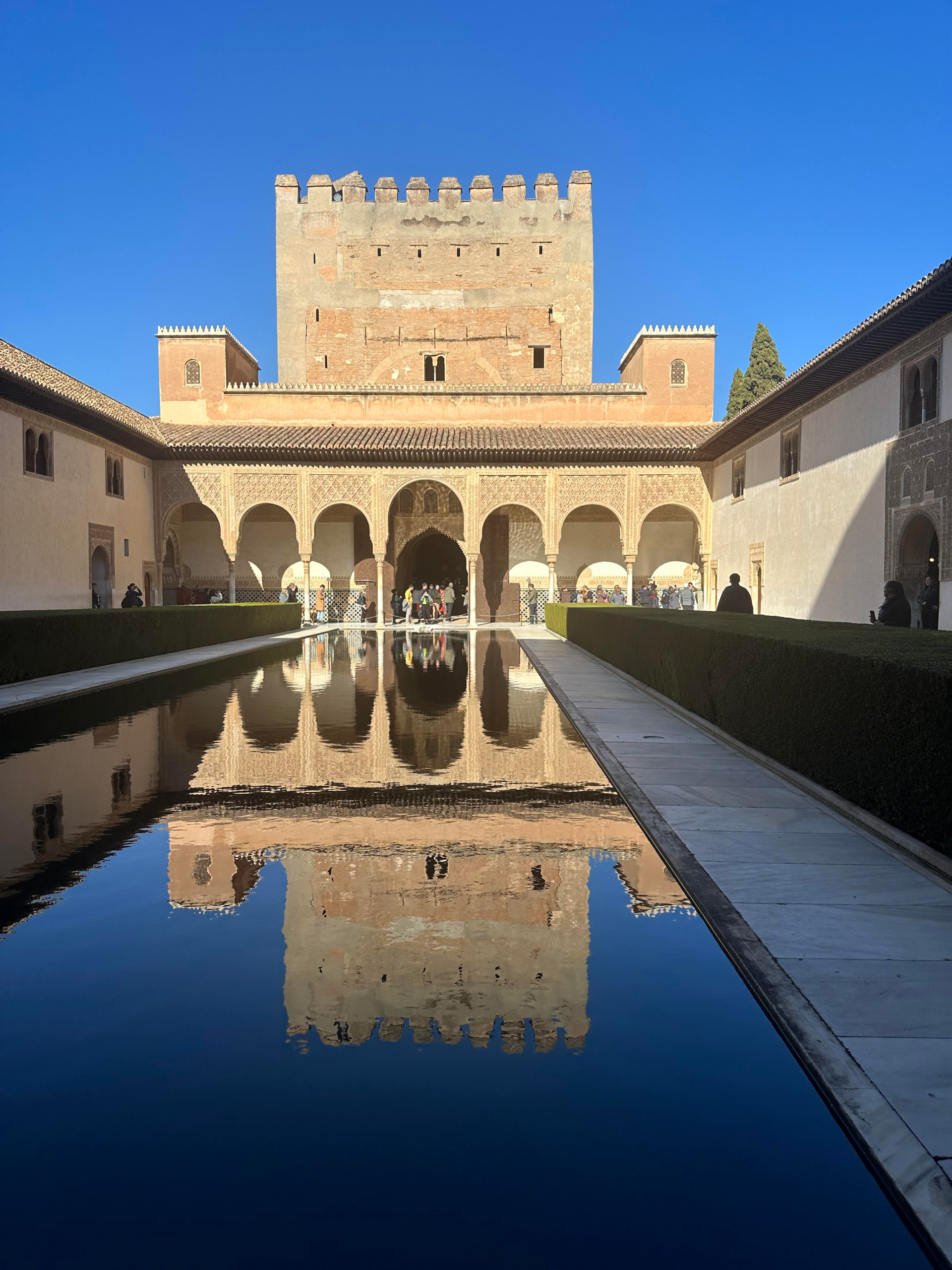
Few cities in the world possess the kind of spell Granada casts on those who walk its narrow streets. Nestled at the foot of the Sierra Nevada, Granada feels like a living poem; a harmony of Moorish palaces, gypsy rhythms, and whitewashed labyrinths. This city, once the last Moorish stronghold in Spain, has preserved an extraordinary blend of history and spirit that captivates travellers and locals alike.
I visited Granada in February, expecting a quieter, cooler version of Andalusia. What I found was a city alive with contrast and streets pulsing with music, laughter, and the irresistible rhythm of Spanish life. Even in winter, Granada is buzzing with energy and the sense of warmth that I find is truly unique to Andalusia.
Getting to Granada: Buses & Trains
I travelled to Granada from Málaga by bus, and it couldn’t have been easier. The company ALSA operates frequent services from Málaga’s main bus terminal, with the journey taking around 1 hour 45 minutes, depending on traffic. There are roughly 40 buses a day covering this route, and tickets usually cost between €9 and €14.
If you’re planning multiple trips around Andalusia, ALSA also offers a Frequent Traveller Pass available for 3, 4, 10, 20, or even 40 journeys — which brings the cost per trip down to between €7.85 and €6.60. It’s a great option for anyone exploring the region by bus.
You can also reach Granada by train, though services are less frequent and generally a bit more expensive. The Avant train from Málaga takes around 2 hours, and you can check schedules and prices directly on their website.
If you’re coming from Seville, the journey is slightly longer than from Málaga, but both Avant (train) and ALSA (bus) operate regular connections. The bus takes around 3 hours, while the train is faster at about 2 hours 25 minutes.
The Alhambra: Granada’s Crown Jewel
Built during the Nasrid dynasty in the 13th and 14th centuries, the Alhambra is not just an architectural masterpiece; it’s a universe of beauty, symmetry, and poetry. The Alhambra is Granada’s crown jewel and Spain’s most visited site.
Naturally, the first thing we did was, of course, visit the Alhambra!

Plan Ahead: Tickets and Timing
I’d read that February was “low season,” but even then, it was VERY busy. If you’re planning to go, buy your tickets the moment they’re released. Alhambra tickets are issued three months in advance, and they sell out quickly, so it’s essential to plan ahead. This is not one of those “decide on the day” kind of experiences and even in winter, it’s very popular.
Since the Alhambra is huge, we took a guided tour, which I highly recommend. Our guide walked us through the Generalife Gardens, the Nasrid Palaces, and the Court of the Lions, giving us the historical background and context to everything we were seeing.
Honestly, the Alhambra is one of those places that you wouldn’t fully appreciate without a guide. Each courtyard, fountain, and intricate arch has a story, and hearing it explained made the visit so much richer. We had earpieces, which meant we could clearly hear the guide even when passing big groups of people.
Ticket Options: Don’t Miss the Nasrid Palaces
There are two ticket options: one that grants general entry to the Alhambra, and another that includes access to the Nasrid Palaces. I highly recommend getting the Nasrid Palaces ticket; for me, it’s the most beautiful part of the Alhambra. The intricate arches, delicate stucco work, and serene courtyards feel like stepping directly into a Moorish fairy tale.
Views from the Generalife Gardens
From the Generalife Gardens, the view stretches over the city and towards the snowy peaks of the Sierra Nevada, the mountains that awaited us later in the trip.
The Albaicín: A Moorish Maze Frozen in Time
After the Alhambra, we wandered through the Albaicín, Granada’s oldest neighbourhood. Declared a UNESCO World Heritage Site alongside the Alhambra. Its narrow, cobblestoned streets twist and turn like a maze, each corner revealing something unexpected; a tiled fountain, a tiny café, or a glimpse of the Alhambra glowing amber in the afternoon sun.
From the Mirador de San Nicolás, we watched the sunset paint the palace gold while a guitarist played nearby. It felt like every postcard I’d ever seen of Spain suddenly came to life. The very same breathtaking view has inspired artists, writers, and travellers for centuries.

Sacromonte & Flamenco in the Caves
One night we climbed higher into Sacromonte, where the homes are carved directly into the hillside. These cave dwellings, or cuevas, have been part of Granada’s landscape for centuries, especially among the Gitano (gypsy) community.
Inside one of the cuevas in Sacromonte, we experienced Zambra Gitana — a form of flamenco unique to Granada. Born in the caves inhabited by the gypsy community, the word zambra comes from the Arabic zamra, meaning flute, which already hints at its deep musical roots and passionate rhythm.
The performance was unlike anything I’ve seen before; raw, intimate, and electrifying. The cave was small, everyone was seated close together, and as the dancer began to move, the entire room seemed to pulse with energy. That night, I truly understood what people mean by duende — the mysterious, emotional soul of flamenco that can move you to tears without a word.
Free Tapas Culture in Granada
Unlike most cities in Spain, here every drink you order comes with a free tapa; no menus, no choices, just a surprise from the kitchen each time.
It’s a beautiful tradition, one that feels like a gift. You can’t ask for specific tapas; you simply accept what comes and enjoy the experience. Sometimes it’s a slice of tortilla, other times crispy fried fish or warm chorizo. With each round, the dishes seem to get better.
Our favourite place, hands down, was Bar Los Diamantes. The fried bacalao (codfish) there was easily the best I’ve had in Spain, perfectly golden and salty. It’s one of those places where you stand shoulder to shoulder with strangers, laughing over beer and tapas, and somehow feel completely at home.
If you want to understand the essence of free tapas culture Granada, Bar Los Diamantes is a great place to start.

Skiing in Sierra Nevada: The Southernmost Ski Resort in Europe
Just 45 minutes from the city lies Sierra Nevada, the southernmost ski resort in Europe. We spent a day there skiing under clear blue skies, gliding down snowy slopes while knowing the Mediterranean isn’t far beyond the mountains — a surreal combination of winter and sun.
The resort is fantastic for beginner skiers. It’s modern, well-run, and has excellent facilities, but I’d recommend avoiding weekends, it’s incredibly popular with Spanish families, and the queues can get long. On weekdays, it’s meant to be relaxed and spacious.

We skied at Borreguiles, which is ideal for beginners thanks to its wide, gentle green slopes. I also booked a lesson with the English Ski School, and it was the perfect experience. My instructor spoke fluent English and immediately understood my level, I had skied before but wanted to refresh my skills, especially since I come from Malta, where we have plenty of sea but no snow!
The school made everything easy, even helping me arrange my ski equipment and showing me exactly where to get my day ski pass. You can buy passes directly on site from the machines or online in advance, where you’ll also find details on the different types of passes available depending on your time and budget.
It’s a rare kind of trip where you can ski in the morning and enjoy by evening. That’s the magic of Granada.
Where We Stayed
We stayed right in the city center, just a short walk from Plaza Nueva, the historic heart of Granada, and about 15 minutes on foot from the Alhambra. The location couldn’t have been more perfect — surrounded by tapas bars, charming alleyways, and lively squares.
👉 If you’re looking for a place that’s central, comfortable, and close to everything, check out this accommodation — it’s where we stayed, and I’d happily book it again.
Happy Travels! x
Travel is better when shared. Come be part of my journey on Instagram @journeywithme.mt, where I swap stories, tips, and travel inspiration with fellow explorers.
Disclaimer: All content and photos in this blog post are my own unless otherwise stated. Please do not copy, reproduce, or use any images or text without written permission.
Affiliate Disclosure: This post contains affiliate links for travel services I use and love, such as experiences and hotel bookings. If you click and make a booking, I may receive a small commission which helps support this site. This does not affect the price you pay.
Thank you for supporting my work — it helps me keep sharing free travel guides and tips!