
This guide is something I’ve truly poured my heart into. It’s built on my local insight and first-hand experience, with the aim of giving you everything you need to plan your trip with ease.
You’ll notice there are very few affiliate links here. Instead I direct you to official websites for entry tickets, and I only recommend tours I genuinely believe are worth your time and money. No tourist traps, no fluff; just smart timing, thoughtful routes, and places I’d happily visit myself.
You’ll also notice that there are no beaches included in this itinerary. It’s designed specifically for visits between October and May, to highlight that Malta is far more than a summer destination.
That said, many of these places can still be enjoyed all year round. If you’re planning a summer visit and looking for a more beach-focused itinerary, keep an eye out; I’m currently working on one and will be sharing it soon.
Keeping This Guide Independent
If this itinerary helps you make the most of your trip, I’d be incredibly grateful for your support via the link below. Any contribution, no matter how small, is sincerely appreciated and helps me continue creating detailed, honest guides like this.
Where to Stay in Malta: What Every Traveller Should Know
Before we start, here’s my first tip. Malta feels very different in winter compared to summer. Mellieħa is largely made up of beaches and, while it’s stunning in the warmer months, it’s very quiet in winter. For that reason, I only recommend staying there between May and September, latest October.
For off-season visits, Valletta and nearby areas such as Sliema, Gżira, and Floriana are far better options. They’re lively year-round, close to the capital, and easy to navigate using public transport.
For more insider advice on each area, including seasonal pros and cons, check out my Where to Stay in Malta guide.
Getting Around Malta Efficiently
Getting around Malta is simple once you know the local system. There are no trains or trams—just buses, taxis, and ride-hailing apps. If you’re on a budget, direct buses from the airport take you almost anywhere for €3 per person, with Valletta as the main hub.
For more convenience or group travel, Bolt and Uber operate efficiently and affordably, download their apps before you arrive to compare fares. The bus system works well, but keep in mind it can run late or get crowded, especially in summer heat, making a Bolt ride more comfortable if budget allows.
If you plan to rely solely on buses, consider the unlimited travel card or group journey bundles. And for trips to Gozo or Comino, ferries are easy to use—full details are in my complete Malta transport guide.
I wouldn’t particularly advise driving yourself: traffic and parking can be a nightmare. If you’re visiting for just 4–5 days, skip the car—it will cost you less and save a lot of stress to rely on buses, Bolts, or a combination of both. If you do plan to drive, check out my driving in Malta guide, which covers everything you need to know.
Malta in 4 Days + Gozo & Comino
Four days in Malta is a tight schedule, but below I’ll show you exactly which stops to prioritise, which ones to combine, and what you can skip to make the most of your time.
To get a feel for Gozo and Comino, you’ll need at least 5–6 days. I’ve put together the ideal itinerary below; if you have fewer days, simply pick and choose the locations that interest you most.
Let’s jump right in!
Day 1 – Valletta
Malta’s history is long and layered, and Valletta sits right at the centre of it all.
Founded by the Knights of St. John and named after Grand Master Jean de la Valette, Valletta quickly became Malta’s military, religious, and cultural heart. Over the centuries, the city has lived through different chapters; the grandeur of the Knights’ era (Valletta was founded in 1566), the British rule (19th – 20th century), and the heavy bombing of World War II, when Malta was awarded the George Cross for its bravery.
Today, Valletta is a UNESCO World Heritage Site, carefully rebuilt and incredibly dense in history. For such a small city, there’s an extraordinary amount to see, which is why I always say the best way to experience Valletta is on foot.
Note that Valletta is hilly, which may be challenging for those with mobility issues.
Walking Tour Options
Walking tours are my preferred way of discovering a new city, especially one as layered as Valletta. If you’d prefer to explore with a guide, these are three excellent walking tour options depending on your interests:
- Valletta Walking Tour (2.5 hours | €20 | Everyday)
Ideal if you want a solid introduction to the city’s history, landmarks, and layout without committing too much time. - Valletta Walking Tour + St. John’s Co-Cathedral (3 hours | €22 | Wed & Fri)
A great option if you want deeper historical context and a guided visit inside Malta’s most important church. Entry to St. John’s Co-Cathedral is paid separately at the door (€15). - Valletta Food Walking Tour (3 hours | €55 | Mon, Tue, Thur, Fri & Sat)
Perfect for food lovers as this tour combines local history with traditional Maltese dishes and street food along the way.
If you prefer to explore independently, here’s a DIY walking route you can follow at your own pace and adjust as you go.
Start: Triton Fountain
Begin at Triton Fountain, the main entrance into Valletta. Walk straight through City Gate to see the Parliament Building designed by world-renowned architect Renzo Piano and the open-air theatre built on the ruins of the old Royal Opera House.
Republic Street
Continue down Republic Street, Valletta’s main artery, lined with shops, cafés, restaurants and historic buildings.
Coffee Stop: Caffè Cordina (1837)
Just before St. George’s Square, stop at Caffè Cordina, one of the oldest cafés in Europe and a Valletta institution. Personally, I love stopping here for pastizzi.
St. John’s Co-Cathedral (Must-See)
If you visit one church in Malta, make it this one.
- Open Mon–Sat, 9:00–16:45 (last entry 16:15)
- Allow 1.5 – 2 hours
- Book tickets in advance (unless visiting on a guided tour)
- Visit at 9:00am for fewer crowds
Inside, you’ll find Caravaggio’s The Beheading of St John the Baptist — his largest work and the only one he ever signed.


Despite its plain, almost austere façade, St. John’s Co-Cathedral hides one of the most richly decorated interiors in Europe, layered with gilded stone, marble tombs, and Baroque detail.


Merchant Street & St. Lucia Street
Wander along Merchant Street, Valletta’s second main artery, full of shops, cafés and restaurants.
From here, walk down St. Lucia Street, one of Valletta’s most picturesque streets, toward the bastions.

St. Barbara Bastions & Bridge Bar Area
One of the most atmospheric parts of Valletta. Expect narrow streets, colourful Maltese balconies, churches, and stunning views over the Grand Harbour — in my opinion, the most beautiful harbour in the world.
The area around Bridge Bar is especially photogenic, with red British-era phone boxes.’

Upper Barrakka Gardens
Finish your sightseeing at Upper Barrakka Gardens, one of Valletta’s best viewpoints, sitting high above the Grand Harbour with uninterrupted views of the Three Cities: Cospicua, Senglea, and Vittoriosa.

Cannon Firing:
The cannon firing is a historic tradition dating back to the Knights of St. John, originally used to signal the time and salute ships entering the Grand Harbour. Today, it remains one of Valletta’s most iconic daily rituals.
- 12:00 or 16:00 (Mon–Sat)
- Arrive 10–15 minutes early for a good spot
Below is a suggested route map to help you easily follow the stops mentioned above.
For History Lovers
If military and religious history interest you, consider:
- St. Catherine’s Monastery – A peaceful escape and insight into Malta’s religious heritage.
- Fort St. Elmo & the National War Museum – Covers 7,000 years of Maltese military history, with highlights from WWII, including the Gloster Sea Gladiator Faith and the George Cross.
- Lascaris War Rooms – Underground tunnels and bunkers used during WWII; a fascinating glimpse into Malta’s strategic role.
- The Grand Master’s Palace – Once the seat of the Knights of St. John and today the Office of the President of Malta, the palace offers a look into Malta’s political history, with richly decorated state rooms and one of Europe’s finest armoury collections.
Tips for Making the Most of Valletta
If I only had 4 days in Malta and was spending one of them in Valletta, here’s exactly what I’d do to make the most of my time:
1. Plan Around Crowds (Cruise Liner Days)
Valletta is busy year-round, but it gets noticeably more crowded on days when cruise liners dock. Ships arrive throughout the year, and many passengers spend the day in Valletta.
As a general rule of thumb, there is always a cruise liner docking on Wednesdays, and occasionally on other days too. If you want to avoid peak crowds, it’s worth checking the cruise schedule website to see which days ships will be in port during your visit.
2. Start With a Guided Walking Tour
I’d begin the day with a guided walking tour, which is hands down the best way to understand Valletta’s history and layout.
If you’re visiting on a Wednesday or Friday, choose a tour that includes St. John’s Co-Cathedral, as it saves time and helps you avoid queues.
3. Visiting St. John’s Co-Cathedral (Read This Before You Go)
St. John’s Co-Cathedral is a must-see in Valletta — don’t skip it.
- Join a guided tour if possible: groups skip the main queue.
- There are usually two lines:
- one for ticket holders (moves fairly quickly)
- one for visitors without tickets or a guide (slower)
Important things to know before entering:
- All bags are checked at security
- Food and drinks are strictly prohibited
- Backpacks must be worn on the front
- Shoulders and knees must be covered — it’s a place of worship
Very important tip: bring your own headphones. The co-cathedral has an excellent official audio guide app in multiple languages, but headphones are not provided.
4. Time Upper Barrakka Gardens Correctly
Plan your visit to Upper Barrakka Gardens for the 4 PM cannon firing. It’s generally less busy than the midday firing.
5. Don’t Overpack Your Day
If you’re short on time, choose a maximum of two major sites from:
- St. John’s Co-Cathedral
- Grand Master’s Palace
- Lascaris War Rooms
- Fort St. Elmo & the National War Museum
- St. Catherine’s Monastery
Trying to see more in one day feels rushed. If you want to explore Valletta properly, plan 2–3 days instead.
6. Eat Your Way Through Valletta
Valletta has some of Malta’s best restaurants. For more top spots across the island, check out my full guide here.
Quick Bites & Cafés
- Caffè Cordina, Croce Bonaci Caterers – coffee & pastizzi spots
- Manouche, Kingsway, Elephant Shoe – brunch-style breakfast
- Piadina Caffè & Grano – perfect for a light sandwich lunch
- SPAR Express — while technically a supermarket, it’s a great spot for freshly made focaccia and other baked goods.
- Phoenicia Hotel – excellent for tea and scones or a classic British-style afternoon tea
- Sottozero — my favourite for crepes and ice cream
Casual to Mid-Range Meals
- Zero Sei, N’duja Osteria, Sotto Pinsa, San Paolo Naufrago – Italian favourites, small and very popular, so book ahead
- King’s Own Band Club – a mix of traditional Maltese and Italian dishes; one of my personal go-to spots, booking is essential, especially on weekends with live music
Upscale & Special Occasions
- Grain Street, Rubino, 59 Republic, Palazzo Preca, AKI
- Michelin-starred: ION Harbour, Under Grain, Noni
7. Valletta Nightlife
Valletta’s nightlife is perfect for enjoying good drinks, music, and platters without the chaos of the younger-party scene in Paceville.
- Strait Street – the main nightlife hub, dotted with small bars. Two of my favourite spots here are Trabuxu Wine Bar and Yard 32 Gin Bar.
- Bridge Bar and Café Society – slightly away from Strait Street, both are great for drinks in a calmer setting.
- La Bottega – for weekends, a more upbeat vibe if you’re after something livelier.
Day 2 – The Three Cities, Mdina & Rabat
Today, you’ll spend the morning exploring the historic Three Cities, followed by an afternoon in Mdina, the Silent City, and nearby Rabat.
The Three Cities — Birgu (Vittoriosa), Bormla (Cospicua), and Isla (Senglea) — are packed with history. Thanks to their strategic position opposite Valletta, they played a crucial role in Malta’s story. This is where the Knights of St. John first settled in 1530, turning the area into a fortified maritime base that protected the Grand Harbour through the Great Siege of 1565, and later during the French and British periods. Without context, it’s easy to miss just how important these cities were.
To really maximise your time, I highly recommend starting with a half-day guided tour of the Three Cities. While it’s possible to visit independently, a guide adds real value; without that context, the streets, although beautiful, can feel quiet and residential, and it’s easy to miss just how important this area was to Malta’s history.

Half-Day Guided Tour of the Three Cities
For €39 per person, this tour includes:
- Hotel pick-up and drop-off*
- Guided walking tours of Birgu (Vittoriosa) and Isla (Senglea)
- A traditional boat ride across the Grand Harbour
- A licensed guide who brings the history to life
*You can also choose to end the tour in Birgu, stay for lunch or drinks by the marina, and then take a Bolt or bus either back to your accommodation or straight to Mdina later in the day.
The tour starts at 09:45 and lasts 4 hours, which I find is the perfect amount of time to explore the Three Cities and it still leaves you plenty of time to visit Mdina and Rabat later in the day.
That said, I know not everyone enjoys guided tours. Below, I’ll also share a walking route covering the key highlights, so you can decide whether you’d rather explore with a guide or independently.

Visiting the Three Cities Independently
If you prefer to explore on your own, the Three Cities are especially rewarding if you enjoy photography and slower wandering.
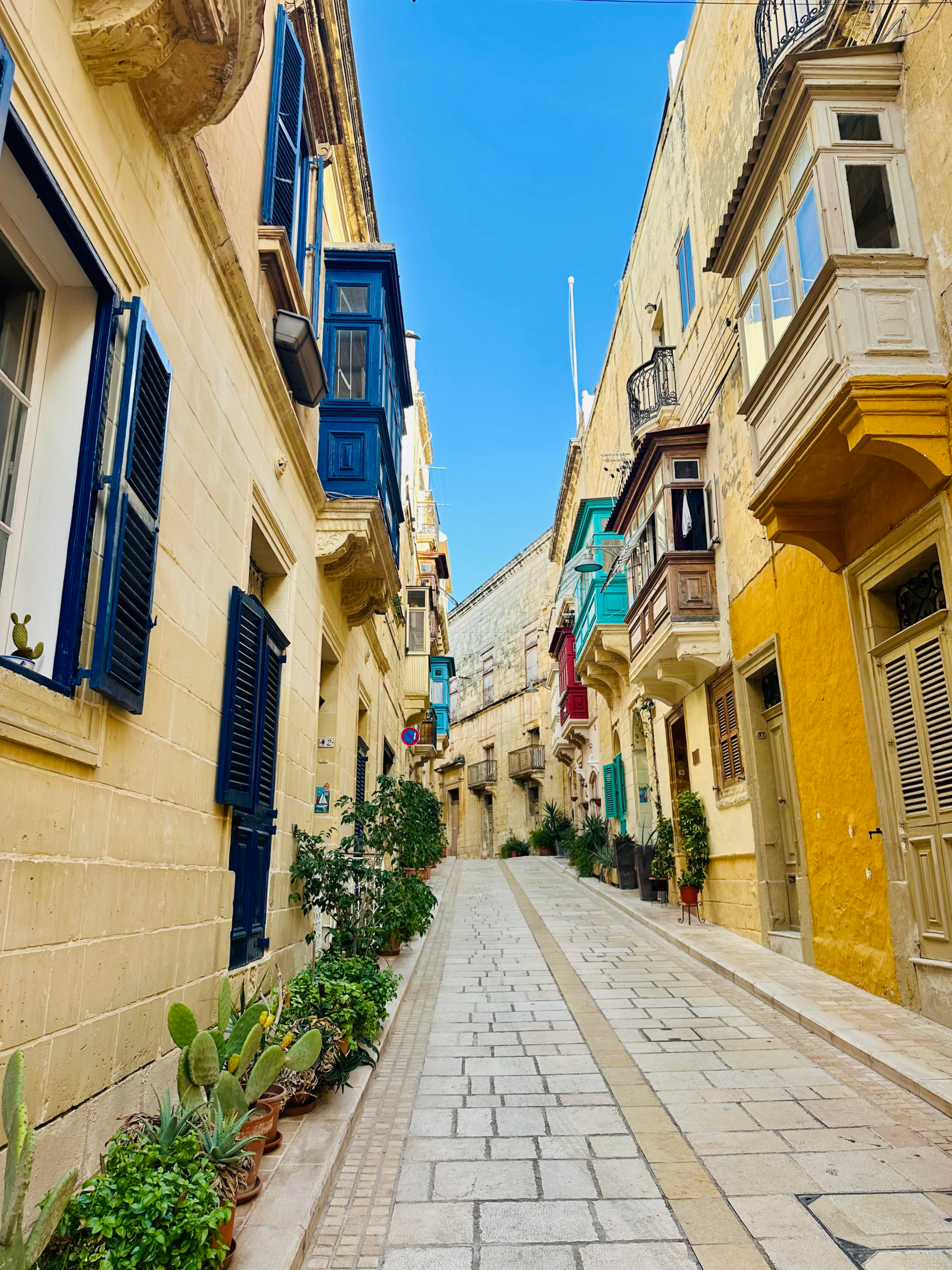
In my opinion, Birgu is the star of the Three Cities. Many locals live here in traditional Maltese townhouses, something that’s becoming rarer elsewhere on the island. Expect colourful wooden balconies, pot-lined streets, and a beautiful marina filled with yachts and waterfront restaurants.
Getting there:
- Bolt or bus from anywhere on the island
- Ferry or traditional dgħajsa tal-pass from Valletta’s Lascaris Terminal (take the lift from Upper Barrakka Gardens)
Birgu Back Streets (8-minute walk)
For a short but charming stroll through my favourite streets, start at Victory Square and walk along:
- Triq il-Palazz ta’ l-Isqof
- Triq Gilormu Casser
- Triq Hilda Tabone


It’s a quiet loop packed with character. I’ll link the exact Google Maps route below.
The Birgu–Isla Waterfront Walk
The Birgu waterfront is perfect for a relaxed drink or meal overlooking the marina.
From the Birgu waterfront, walk towards the ferry terminal (technically in Bormla) and cross the pedestrian footbridge into Isla. To find it easily on Google Maps, search for DATE (Art Café).
From there, walk uphill to Gardjola Gardens, about 30–35 minutes from the Birgu waterfront. The climb is worth it; the gardens offer stunning views over the Grand Harbour, the same views as Fort St. Angelo but free.
Fort St. Angelo (€10 entry) is impressive, but unless you’re especially interested in military history, I’d recommend prioritising Gardjola Gardens for the views alone.

Cospicua (Bormla)
Cospicua is mainly residential and doesn’t have as many must-see attractions. Unless you’re particularly interested in photography or architecture, it’s the one city you can easily skim or skip.
A Special Note: Birgu Fest
Every year, Birgu comes alive during Birgu Fest, when the streets are lit by thousands of candles, creating a magical atmosphere.
2026 dates: Friday 9th & Saturday 10th October
If your visit lines up with this weekend, don’t miss it.

Spend an Afternoon in Malta’s Silent City
After a slow morning exploring the Three Cities, head to Mdina, Malta’s “silent city.” Afternoon visits are best; the light is magical, and the crowds are smaller. While in Mdina, don’t miss Rabat, just across the road.
Mdina, known as Malta’s “Silent City”, is a fortified town with a history spanning over 4,000 years. Originally a Phoenician and Roman settlement, it became Malta’s medieval capital, with massive walls built to protect against invaders. Narrow, winding streets lead past palaces, churches, and baroque buildings, giving the city a timeless, almost storybook charm. In the 16th century, when the Knights of St. John established Valletta as the new capital, Mdina became quieter, earning its nickname.


Mdina is very small, so you don’t need much time to see it, but I recommend setting aside 2–3 hours to wander slowly. The narrow alleys, quiet atmosphere, and stunning Baroque architecture make you feel like you’ve stepped back in time.
Start at Mdina Gate, which you might recognise from Game of Thrones. From there, continue to Pjazza Mesquita, another filming location. You’ll find a wine bar and café here, but I suggest holding off on drinks or snacks and continuing your exploration.


Wander through the back streets toward Bastion Square, passing the Instagram-famous blue door with pink bougainvillea. Fun fact: that door belongs to a rental unit called The Bastion on Airbnb. It’s pricey and requires a minimum five-night stay, but now you know it exists if you’re curious.
Once at Bastion Square, the widest open space in Mdina, enjoy sweeping views of Malta’s countryside. To the right, stop at Fontanella Tea Garden for a sweet treat and a coffee. The reviews can be mixed, but for a simple cake and the view, it’s perfect.

Your next stop is the façade of St. Paul’s Cathedral, a stunning Baroque landmark in the heart of Mdina. It’s the historic seat of the Maltese Archbishop and considered the spiritual mother of all Maltese churches. Entry costs €15 for the cathedral and museum, but admiring it from the outside is perfectly fine; especially if you’ve already visited St. John’s Co-Cathedral in Valletta.
Finally, head back through Mdina Gate and stroll along Howard Gardens on the right to reach Rabat.
Below is a map of all the mentioned stops, so you can follow the route with ease:
Alternatively, you can join a walking tour; by now you’ve probably realised I’m a big fan of them. This tour is the only one that runs in the afternoon, starting at 3 PM and lasting 2.5 hours visiting both Mdina and Rabat. Most others take place in the morning, but remember my tip about visiting Mdina later in the day; it’s worth it. Trust me.
Rabat is more than just Mdina’s neighbour and a great place to end the day. I highly recommend having dinner in Rabat, where you’ll find a more authentic atmosphere than in Malta’s more touristy areas. Before or after your meal, stop by Crystal Palace, known locally as Is-Serkin, for what are widely considered, and in my opinion truly are, the best pastizzi on the island.

At just €0.60 each, they’re worth buying even if it’s only for a bite; you’ll quickly understand the hype. Is-Serkin also functions as a traditional tea bar where locals gather, offering a glimpse into everyday Maltese life that is becoming less of a norm, especially in touristic areas.
A note for winter visitors: Natalis Notabilis
If you’re in Rabat between December 4th and 13th, the town hosts Natalis Notabilis, one of Malta’s best Christmas markets. Check out my post here for more details; I’ll also be sharing the exact dates as soon as they’re announced.
Day 3 – Marsaxlokk, Blue Grotto & Dingli Cliffs
Today you’ll be exploring Malta’s south. The easiest way to get around is by Bolt or Uber, but if you prefer the bus, you’ll need to head to Valletta first. Take 81 or 85, or TD10 on Sundays.
Marsaxlokk is Malta’s classic fishing village, where the colourful luzzu boats float in the harbour and the Sunday fish market is a lively local tradition. The village has been a hub for fishing and maritime life since Phoenician times, letting you glimpse how generations of fishermen have lived and worked along Malta’s coast.
Start at Marsaxlokk Bay, known for its colourful luzzu boats and waterfront restaurants serving mostly seafood. Photographers will love the vibrant luzzus against the backdrop of the sea, sky, and church.


On Sundays, the bay hosts the Sunday Fish Market, where fresh seafood is sold. Personally, I’m not a fan of fish, as the smell can be strong, but if you enjoy local flavours, it’s worth visiting early, around 9 AM.

Time needed: 2 hours in Marsaxlokk is plenty, or 3 if you include St. Peter’s Pool.
St. Peter’s Pool
Marsaxlokk is also the jumping-off point for St. Peter’s Pool, a natural swimming pool with crystal-clear water. In summer, it’s a hotspot for younger visitors and cliff-jumping. There are no amenities (no umbrellas, deckchairs, or shade) and getting there by public bus involves a 30-minute walk from the nearest stop. Parking can also be tricky.
My top tip? Take one of the organised luzzu trips from Marsaxlokk Bay (€10), which take you along the coast, past Delimara and the salt pans, with St. Peter’s Pool as the final stop. In summer, these boats work like a shuttle: hop off to swim for 30–60 minutes, then hop back on.

Ħal Saflieni Hypogeum (Optional)
If you’re fascinated by ancient history and archaeology, the Ħal Saflieni Hypogeum is a must-visit. This underground prehistoric burial site dates back over 5,000 years and is one of the most unique archaeological sites in the world.
Open 9 AM to 5 PM, visits are strictly guided and last about 50 minutes, as solo touring isn’t allowed. To protect this fragile site, daily visitor numbers are capped at just 10 visitors per hour, so tickets must be purchased online well in advance.
Ticket prices are €35 for adults, €15 for children (6–11), and €20 for students and seniors (60+). As of January 2026, tickets can be booked months in advance through the end of the year, and it’s highly recommended to secure them as soon as possible, as they often sell out due to the strict visitor limit. A few last-minute tickets may be available 24 hours in advance for €50 per person, but these must be purchased in person at St. Elmo in Valletta.
It’s important to note that no photos are allowed inside. Cameras and mobile phones must be left in the provided lockers. If you want to see images beforehand, you can visit the Heritage Malta website for an official preview.
I want to be completely transparent: I’ve visited myself. The history and archaeology are astonishing, but I felt that the overall experience and presentation didn’t fully live up to the price. I’ll let you decide if it’s worth it for you — for some, the chance to see such a unique prehistoric site is unforgettable, while others may find it underwhelming.
Getting there from Marsaxlokk is straightforward: take bus number 80, 81 or 82 towards Valletta, stop at “Pjazza” and follow the short walk to the site. For anyone with a keen interest in history, ancient rituals, or Maltese heritage, a visit here is truly unforgettable.
Blue Grotto & Wied iz-Zurrieq
From Marsaxlokk (or the Hypogeum), take a Bolt or Uber to the Blue Grotto (~15 min). There’s no direct bus. First, stop at the Blue Grotto Viewpoint for stunning panoramic views. From there, it’s an 800-meter downhill walk (~10–15 min) to Wied iz-Zurrieq, the departure point for boat trips to the Blue Grotto caves. For reference, you can search Step In on Google Maps — it’s a restaurant right by the boat departure point.

Boat tours cost €10 (cash only) and provide a short, scenic ride to the caves. Tours may be cancelled in windy conditions, so check the weather ahead. Afterward, enjoy a drink or lunch at one of the waterfront restaurants — Aalto is a superb choice and, in my opinion, the best spot at Blue Grotto for food. The views are spectacular on a sunny day.
Off in the distance, you’ll see Filfla, a tiny, uninhabited rocky island and protected nature reserve, home to rare birds and plants, providing a striking backdrop to the coastline.
Dingli Cliffs
Next, head to Dingli Cliffs for a walk along Malta’s majestic western coastline. Start at St. Mary’s Magdalene Chapel, then stroll toward either Bobbyland Restaurant or, for a more adventurous route, the viewpoint Gebel Ciantar — a natural “window” opening onto the cliffs and sea.

Dingli Cliffs are stunning at any time of day, but my personal favourite is just before sunset. Sitting on the island’s west side, the cliffs offer spectacular sunset views.

Day 4 – Sliema & St. Julians
Sliema and St Julian’s were originally small coastal settlements focused on fishing and maritime activity, but their development accelerated during the British period, when Sliema became a residential area for British officers and professionals. In the 20th century, especially after World War II, both towns underwent rapid urbanisation, with villas and open spaces replaced by apartments, hotels, and commercial buildings.
After exploring Malta’s historic cities, visiting Sliema and St Julian’s gives you a sense of the island’s modern side. Today, they are among Malta’s most cosmopolitan areas, known for tourism, nightlife, international businesses, and a diverse population; reflecting Malta’s evolution from a traditional society to a more globalised, urban lifestyle.


Sliema & Tigné Point
Personally, I feel that the vibe in Sliema is fantastic all year round. It has a relaxed expat feel, right by the sea, with a lovely promenade, plenty of shops, restaurants, and cafés. Sliema is buzzing no matter the season and makes a wonderful base for exploring Malta. Located just across Valletta’s Marsamxett Harbour, it’s central, and convenient. For anyone wanting to experience the island while enjoying easy access to dining, shopping, and seaside strolls, Sliema is one of my top recommendations.
Start the day with a leisurely breakfast at one of the many cafés in central Sliema or right on the promenade in an area known as Qui-Si-Sana. The Compass is a favourite spot for a simple coffee or breakfast, offering magnificent views of the sea. It’s open 24 hours, making it perfect for an early morning sunrise. If you’re staying in Sliema and don’t mind waking up early, a walk along the promenade at sunrise is a simple but incredible experience. The promenade is safe, and you’ll often see locals jogging or strolling both in the early morning and during the evenings.


For shopping or casual browsing, head to Bisazza Street or Tigné Point. From Tigné Point, you’ll also enjoy some of the best views of Valletta’s skyline across the water. If you’re looking for a different perspective, consider taking a Grand Harbour cruise. From the Sliema seafront, it’s also possible to reach Comino, and I’ll share my personal favourite boat tour below; trust me, there are plenty of disappointing options, so you’ll want to pick the right one!


St. Julians & Malta’s Tallest Building
In the afternoon, head to St. Julians from Sliema; it’s just a short stroll, bus, or taxi ride. Start at Mercury Towers, Malta’s tallest building at 120 meters, which doubles as a shopping mall and dining hub. For casual Italian, try Italo for platters, sandwiches, and pasta at good prices. For something fancier, there’s Ruby Ray for Indian cuisine, Luciano by Gino D’Acampo, and the rooftop Mediterranean spot Anima.
While at Mercury, don’t miss the Odyssey immersive experience — a 35-minute journey through Malta’s history in the island’s first Flying Theatre. Tickets are €25 for adults, €19 for students and seniors, €12 for children over 100 cm, with a 15% online booking discount. The best perk? Access to the rooftop platform on the 33rd floor, offering breathtaking 360° views of Malta. If you’d rather skip Odyssey, head to Anima rooftop restaurant.
For a more casual vibe, check out The Eden, a modern cinema, bowling, and arcade complex that was fully refurbished and reopened in July 2024. Nearby, you’ll find Casino Malta and Baystreet Shopping Mall. To reach this side of St. Julians from Mercury, you’ll pass Paceville, Malta’s nightlife hub; lively, but not for everyone. For a quieter evening, stick to Spinola Bay or Portomaso Marina, which offer upscale dining by the sea.
Whether you’re after fine dining, entertainment, or just a stroll by the water, St. Julians has something for everyone and makes a perfect evening spot in Malta.


Day 5 – A Day on Gozo, Malta’s Sister Island
Compared to Malta, Gozo developed more slowly and retained a strong agricultural identity, which is why it is often seen today as quieter, greener, and more traditional, offering a glimpse into a slower pace of Maltese life.
I personally love Gozo and always recommend staying at least 1–2 nights, especially in summer. The beaches are far less crowded, the water is crystal clear, and staying in a traditional farmhouse is something we locals love to do year-round (but especially in the warmer months).
If you only have one day in Gozo, I strongly suggest joining a tour. The real magic of Gozo isn’t found in village centres or along main roads; it’s hidden down dirt tracks and along the coast. While Victoria, the Citadel, and the Ġgantija Temples are all worth visiting, places like Sanap Cliffs, Wied il-Għasri, the Marsalforn salt pans, and Għar il-Mixta are much harder to reach by bus. Even with a car, you’d need more than a day to see them properly; which is why I recommend driving only if you’re staying longer than one night.
Quad vs Buggy Tours
The most adventurous way to explore Gozo is by quad bike tour. You drive your own quad, with a guide leading the way, and you’ll reach some incredible hidden spots like the ones I mentioned above. Jeep tours are also popular, but after trying one myself last year, I can honestly say they’re not the most comfortable; you feel every bump on the trail roads. A much better option, in my opinion, is a UTV tour. They’re more modern, comfortable, and a lot safer overall.
Prices usually range between €80–€115, depending on whether you choose a UTV (cheaper) or a quad bike (more expensive but totally worth it for adventure lovers). The tours I recommend include hotel pick-up and drop-off in Malta, and lunch; and honestly, it’s a day you won’t forget.
Bonus tip: both tours I recommend pass through the Blue Lagoon and the Comino caves, so if you’re visiting in winter (when swimming isn’t really on the cards), you still get to experience Comino without having to dedicate a full day to it.
Other Options
If you prefer to stick to the main sights, both the bus and Bolt work perfectly well in Gozo. Another easy option is the hop-on hop-off bus, which also operates on the island. While I haven’t done this tour myself, I’ve had plenty of tourists tell me that the Gozo route is actually much better than the Malta one.
PS: If you’re planning to stay longer in Gozo, keep an eye out; I’m currently working on a full Gozo itinerary, including a map of all the spots I think truly deserve a visit.
Day 6 – Comino: The Blue Lagoon & More (Optional)
Let’s get this straight — if you’ve ever looked up Malta, you’ve definitely seen that photo of the Blue Lagoon on Comino. And yes, I can confirm: it really is paradise. The water is unreal. But there’s a catch.
Comino is tiny. You can walk the whole island in about 1.5 hours; it’s just over 6 km around. In summer, that dream-like lagoon turns chaotic. The Blue Lagoon alone sees between 6,000 and 12,000 visitors a day, which, paired with one of the smallest beaches you’ll ever see, means crowds, crowds, and more crowds.
Visiting in Summer vs Winter
The good news? This mostly happens between May and October. Visit outside these months and Comino feels like a completely different place. Since it’s not really swimming weather then, I recommend visiting independently. You can take the ferry, buy an open ticket (€15), and come and go whenever you like. The only downside is getting to Ċirkewwa in the far north of Malta, but the freedom is well worth it.
Do I recommend doing Gozo and Comino in one day? Honestly, no. Gozo deserves more than a rushed few hours. That said, a Gozo tour that includes a boat trip past Comino and the caves does make sense and is a good use of time.
If you’d rather focus just on Comino — the Blue Lagoon, Crystal Lagoon, and the caves — this boat tour is my go-to. I’m not sponsored; I’ve simply done it many times. For the same price as most others, you get a comfortable catamaran instead of a cramped boat with hard seats. I even travel from Sliema to St Paul’s Bay to take it; it’s that good. You can still disembark and explore the island too.


What to see on Comino
- Comino Tower – built by the Knights of St John as a defence lookout, it’s now a historic landmark (also featured in The Count of Monte Cristo).
- San Niklaw Bay and Santa Marija Bay.
- The Chapel of Our Lady’s Return at Santa Marija Bay.
In winter, aside from admiring the insane water colours, the best thing to do is hike around the island — quiet, scenic, and honestly one of the best ways to experience Comino.
Visiting in summer? I’ve shared all my tips on how to do it right in a separate post, here.
To Wrap Things Up
This itinerary was created with winter and spring in mind, and while I’m working on a summer version, you can explore more ideas in the Malta Guides section.
If you want a stress-free, tailored experience, I also offer personalised itineraries based on your interests, travel style, group size, or special occasions. Prefer exploring with a private driver? I can arrange that too. Just reach out at [email protected], tell me what you’re looking for, and I’ll help you plan a Malta trip that fits you perfectly.
Follow me on social media for more Malta tips!
Happy Travels! x
Disclaimer: All content and photos in this blog post are my own unless otherwise stated. Please do not copy, reproduce, or use any images or text without written permission.